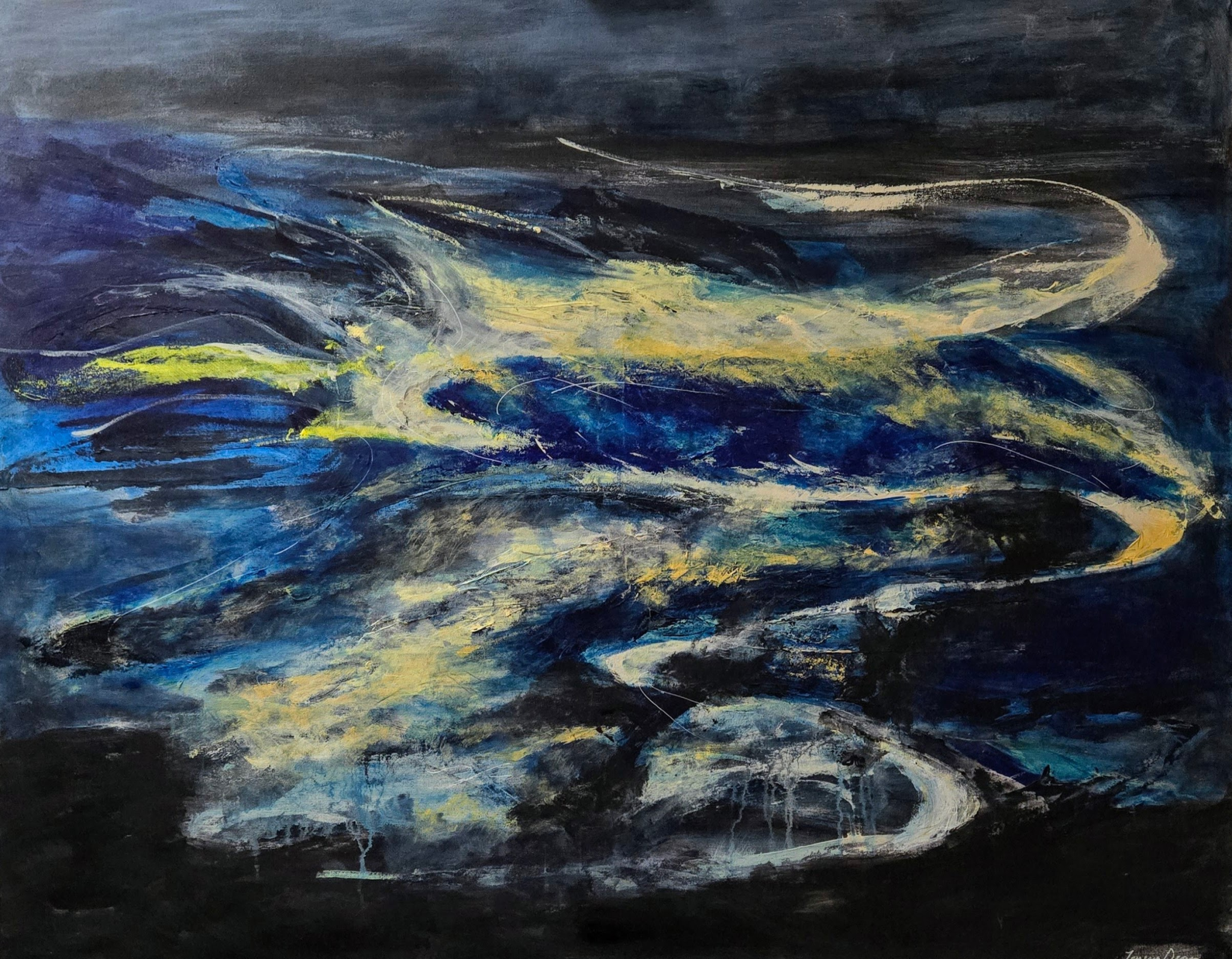
As we usher in a new season of art showcased in the Tucson J Fine Art Gallery, we are excited to feature Terry Dean, one of the talented artists selected to exhibit their work.
In his first solo show, Nature and the Cosmos, Terry Dean, who specializes in abstract expressionism, examines and interprets nature, deliberately distorting the representational features of what we normally see. Subtly, he explores universal themes of the cosmos—that we are small parts of an infinite universe, and that we are subject to universal laws we have only begun to comprehend.
Nature and the Cosmos runs from September 18 through October 19 at the Tucson J, and all are invited to a free reception celebrating the show’s opening on Sunday, September 21 from 2-3:30pm.

How did your journey into art take shape?
My mother lit the spark in my interest in art when I was a boy. An artist herself, she encouraged me to draw, beginning in elementary school. In high school, I took as much art as I could, and on weekends, I would use pastels to create still life paintings. Cezanne was my inspiration. That was the last time I engaged in the visual arts until 3 1/2 years ago, when I resumed pastel painting after spending most of my career as a lawyer and law professor. An art professor friend suggested I try other mediums besides pastels, so I chose acrylic painting. I am self-taught, having studied abstract expressionist paintings on the internet. I learned from my mistakes and have improved my work over time.
Can you share your creative process, both in the studio and in shaping the overall vision for the show?
My creative process is similar to that of when I wrote two novels (both unpublished). I begin with a vision, and the vision evolves over a period of days or weeks. After choosing a palette, I begin by painting a background and introducing layers of paint that reflect the theme of the work. Yet, the process is organic, as I modify the painting–sometimes drastically–during the process.
In a way, the painting paints itself. The process for shaping the vision for the show was much simpler. I have always been interested in nature and astronomy, and the relationship between these two domains. Nature is part of the cosmos, as is astronomy, and so my paintings evoke some of the cosmos by drawing the viewer into a macrocosm that is greater than themselves.
What themes are you exploring in this show, and why are they important to you?
I think the primary theme is that a complex idea–or a complex painting–changes its shape and evolves as we study it. As this process takes place, the impact– either profound or subtle– that the work has on the viewer does not remain static but similarly evolves.
Who is your favorite artist or one you draw inspiration from?
My favorite abstract artist is the French-Chinese painter Zao Wou-ki, whose work embodies the interaction between nature and the cosmos. Yet, perhaps the most inspiring artist for me is Vincent Van Gogh. His art transcends the category of “painting” and enters the realm of the universe.
Is there a particular piece in the show that holds a meaningful story or memory for you?
A number of pieces hold a meaningful memory for me, but perhaps the most significant is “Elegy.” I was attempting to show an abstract landscape in which light emerges from the darkest layers of the forest. Light is more powerful than darkness.
How do you hope viewers feel after experiencing the show?
I hope viewers feel the profound yet indescribable thrill of having been immersed in overwhelming beauty.