From the Desk of Rabbi Samuel M. Cohon | Congregation Beit Simcha, The Too Jewish Radio Show + Podcast
Recently we’ve been reexamining what being an adult male means. In some quarters, “maleness” is defined by Barstool-Sports level crudity, rudeness and violent behavior; in others, masculinity itself is demeaned as intrinsically destructive. Meme-worthy ideas like “Real Men Don’t” are pitted against “Toxic Masculinity.”
So, what truly marks a man as an adult?
This week’s Torah portion of Vayishlach focuses on the man who is the true father of our nation, Jacob, and the way becomes Israel. Throughout his colorful life Jacob has been less than a full man. He is physically strong: he moves a boulder off of a well to impress the pretty Rachel. He has been attractive to women—he has four wives. He has been genetically prolific, having produced 12 children. He has acquired wealth: goats, sheep, livestock, real and valuable property. He is a successful entrepreneur who has maximized his return.
While he is a strong, able man, it is his brother Esau who has always been the athlete, the hunter, toughest guy on the block. Dad liked Esau best, and that wound remains for Jacob, even though clever Jacob conned gullible Esau out of both birthright and blessing.
Jacob has long been a master manipulator, a trickster whose highest priority is always his own needs. Jacob has never yet met a situation he will not turn to his own advantage, always at the expense of others, including his immediate family members. Suddenly here in Vayishlach—in the face of threatened destruction—he realizes it is more important to save others than to save himself.
Jacob is returning to his homeland, Canaan, approaching the border, the Jordan River, when he is informed his wronged brother Esau is coming to meet him at the head of an army. Forced to face Esau, he chooses to do perhaps the first altruistic act of his entire life: he tries to save his family before he saves himself. He divides his family into two camps, sets up a rich bribe for Esau. And then he confronts his fears.
Jacob gets up in the middle of the night, terrified of the coming encounter with his well-armed brother, and goes alone to an island in the river.
We don’t know why he is in this famous wrestling match, nor do we know against whom he wrestles. We only know that Jacob ultimately prevails, at the cost of physical injury, a limp that plagues him the rest of his life. And we know his name is changed to Israel, the name that becomes our name, Am Yisrael, B’nai Yisrael, the People and Children of Israel, the name of the land that will be ours, Erets Yisrael, the Land of Israel.
It is notable Jacob shows physical strength, as we are taught men must. But it is perhaps most noteworthy that Jacob demonstrates his prowess over someone other than a human opponent, “wrestling with God.” For in Vayishlach Jacob overcomes his own Yetzer, his own nature, which has directed him towards selfishness and manipulation. He becomes for the first time a man in full, prioritizing others before himself. When he rises to meet Esau, limping to greet him, he does so with the deepest commitment to his children, his family, and the future of his people and religion.
It is those commitments that mark how Jacob becomes an archetypal Jewish man, dedicated to values that matter most. And it is this moment, this transformative growth, that allows the brothers to surprisingly resolve their life-long differences and reunite.
It is that transformation of our own natures, the ways we grow from adolescence to maturity, that allows each of us to fulfill the commitments we make. May we learn from Jacob’s struggles what it takes to truly be a man: caring about and acting for higher goals than our own selfish concerns: family, peoplehood, religion. May we live for those great moral ideals and go from strength to strength as Israel’s descendants.
As we examine the story of Jacob and Esau in this week’s Torah portion and learn about the importance of thinking of not only about oneself, but about the needs of the communities we are part of, we find parallels to our work here at the Tucson J. As Jacob and Esau ultimately discover the strength that comes from connection and the power of empathy and responsibility, we too are reminded that our programs, services, and daily interactions are rooted in creating a community where every individual is supported, seen, and uplifted.
While we are still a just over a week from Hanukkah, it’s never too early to start celebrating together. This week, team members from the J and the Weintraub Israel Center went to the Lapan Foundation College Prep Academy to share our traditions enjoying tasty latkes, a Star of David craft project, and enthusiastic games of dreidel.
In the art studio, community members let their creative light shine with local ceramicist Russell Kahn in a two-part Hanukkah Ceramics Workshop. Artists designed and hand-built their own menorahs and dreidels, learning fundamental clay techniques and exploring how tradition, memory, and creativity come together in ritual objects. Be sure to check out Russell’s show in the J’s Fine Art Gallery in January.
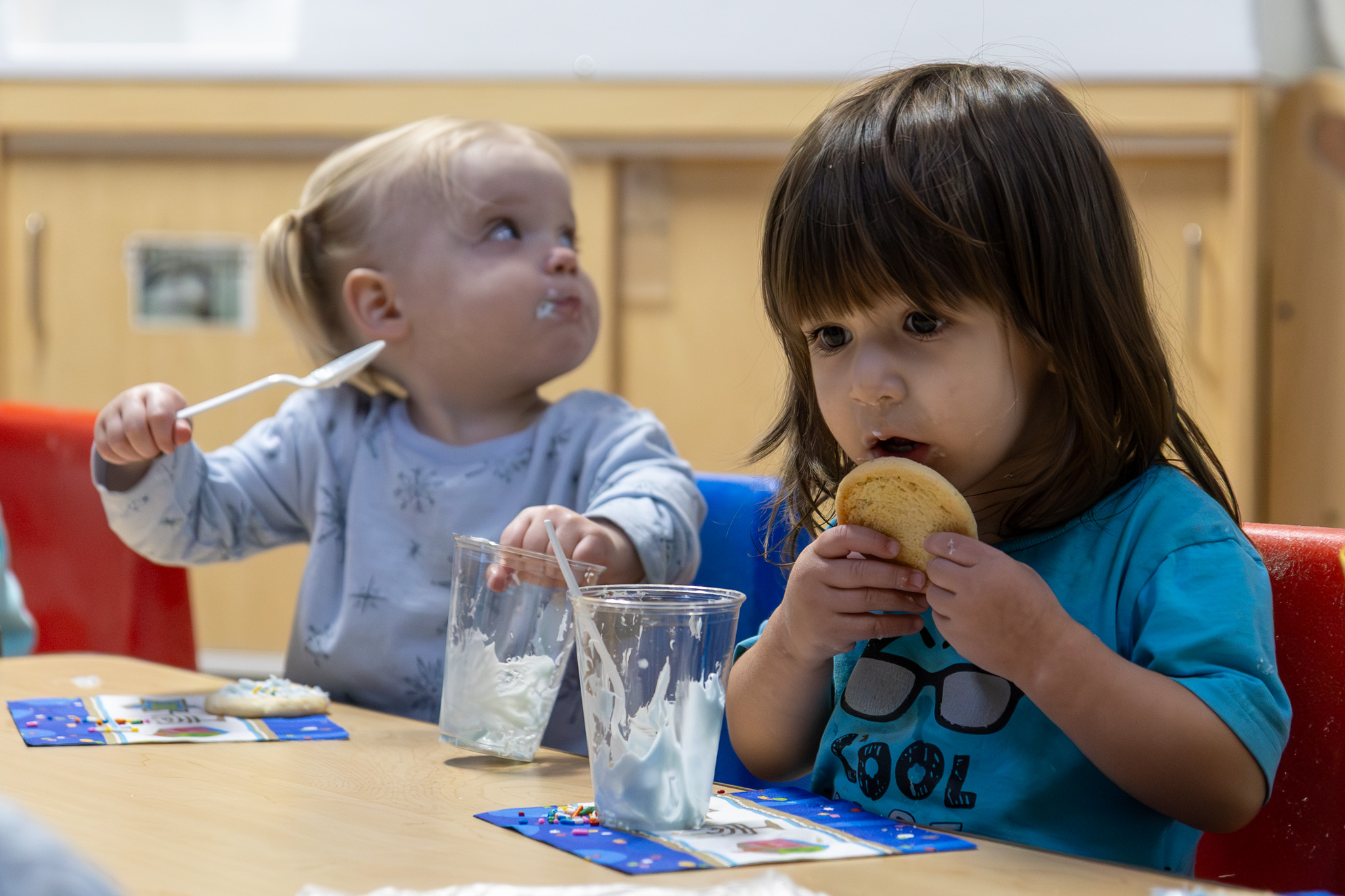
And in Early Childhood Education, students discovered the joy of the Hanukkah through their senses with cookie decorating and Hanukkah songs and stories. On Sunday, we look forward to welcoming many of our ECE families, and many more community members for the 9th Annual Hanukkah Hot Cocoa Run!
As we move into Shabbat and approach the Festival of Lights, may we continue to lift one another up, celebrate the richness of our shared traditions, and kindle sparks of connection that brighten our entire community.
Shabbat Shalom.
Reminders, Resources + Learning
Each week we share resources for more learning:
This week’s resources:
- When Jacob Met Esau: Facing Our Fears by Gordon Tucker (Jewish Theological Seminary)
- Why the Angel Asks Jacob His Name by Rabbi Neal J. Loevinger (My Jewish Learning)
Last week’s resources:
- Jacob Out In The World by Avi Neuman (MyJewishLearning)
- Parshat Vayetze: The Real Housewives of Canaan (BimBam)
Is there a topic you’d like to learn more about? Email Jenn Selco with requests.